



Church gardens across the Diocese of Winchester are not just beautiful spaces but are helping churches connect with their communities, offer places of peace, reflection and friendship, and for some, provide the first steps towards faith.
At St Mary’s Church in Tadley, a once neglected patch of ground has been transformed into a community garden that has become an important part of local life and sanctuary to many residents. The church is situated at the centre of the community and on a route to and from school.


Created during the Covid pandemic, the garden was inspired by Psalm 23 after the Bible Society’s award-winning Chelsea Flower Show garden and designed as a place of hope at a challenging time.
It features a wildflower labyrinth, benches and log seating for quiet reflection. The labyrinth symbolises the journey through life with God at its heart. A cross on a log in the centre reminding visitors of his love. Around it, are 23 rosemary bushes and 23 lavender bushes, echoing Psalm 23.


Revd Steve McKay says the garden helps the community see the church as a welcoming place. For some, it’s a stepping stone to entering the church building.
“Missionally, I think it’s important for the community,” he said. “Not everybody wants to step into a church straightaway, but they will come into the garden.
“When they’re walking around the labyrinth we can have powerful conversations, meeting with them, chatting about life, talking about the fact that the wildflower labyrinth is a journey of life. We talk about their journey, about where God might be in that journey and the garden makes church a much less threatening place if you’ve never stepped into a church building before.”


The garden also creates opportunities to invite people further. Revd Steve continued, “We can say to people ‘Come in and find peace inside as well as outside’. If the garden wasn’t there, they would just walk past. It’s somewhere they can stop and we can meet with them.”
During lockdown, the garden offered people somewhere safe to walk, reflect and simply be. Today it also hosts prayer walks, family events, outdoor services and even a local fitness group.


The church has also created a growing area which is used by the local pre-school three afternoons a week as part of its Forest School curriculum, while the ‘Wednesday Weeders’ volunteer group helps care for the gardens each week. There are also a café session and a service at the church each Wednesday morning.
In addition to this, Tadley Men’s Shed is now based in the church grounds, with members supporting school visits and helping children build bird boxes, boot racks and other projects.
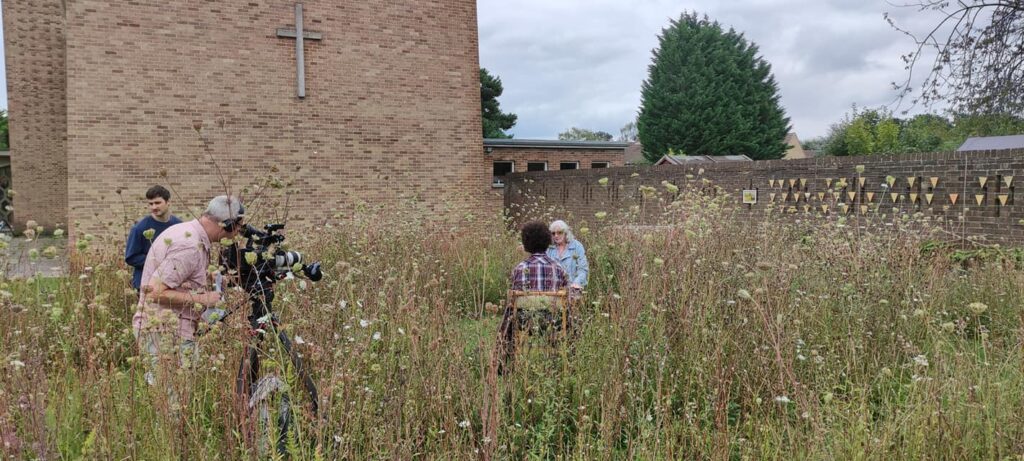
Keith Gillings leads the volunteer gardening team. He said, “You see people sitting on the benches eating their lunch or just sitting quietly. Because of the way the wildflowers and the grasses have grown, you’re at the same level as the wildflowers themselves and the bees, moths and the butterflies, so you’re close to the wildlife. You can unwind, leave your stresses behind and have a quiet think if you need to.”
At St Nicholas Church in Bournemouth, another congregation has discovered how a garden can bring the community together.


When work began in early 2024, the land surrounding the church was described by organiser Julian Davies as a ‘green desert’. “It was just grass, really,” he said. “There was one overgrown ornamental shrub, and that was it.”
Local people were invited to a meeting to help shape the community garden project.
Julian continued, “Much to my astonishment, around 30 people turned up, and we pulled together some ideas. We wanted to create a place which was attractive for people and attractive for wildlife as well. We were keen that we would involve whoever wanted to come. It was and is a community garden for everybody.”


Since then, regular community working parties have transformed the area into a flourishing garden, with those attending from the community as well as the church congregation.
The local Scout group helped design parts of the space, while pupils from nearby St Katharine’s CE School have planted around 120 sunflowers, 200 hedging plants and 900 daffodil bulbs.
The garden has become the setting for plant sales, community events and the return of the church’s Summer Fair. Volunteers grow vegetables that are left outside the church for anyone who would like to take some home. Cake and conversation have become an important part of the regular working parties.


“It’s about establishing something which is making the most of the site in physical terms, but more importantly it’s a community building exercise,” Julian continued.
The project has strengthened links with local organisations including the uniformed groups, schools, the pre-school and the residents’ association who have donated money towards the project.
The garden has also created opportunities for pastoral care as friendships have developed among volunteers.


Julian said, “It’s meant that people have got to know the church as a place where people are friendly and we’ve had a few who have come to worship here as well. It’s made a big difference to the community.
“We have just formed a new parish of Southbourne on Sea, combining three churches, so this is also an excellent opportunity to bring people in and to work together.”
Last year the project was recognised with a gold award from Bournemouth in Bloom in the community garden category. There are new plans for a community orchard.


Both projects share the same vision, to create welcoming outdoor spaces where people can find peace, build relationships and experience God’s love often before they step through the church door.
Revd Steve concludes, “Whether they’re sitting on a bench having lunch, walking around the labyrinth barefoot, it’s somewhere they can just be and there aren’t many places in the world now where you can just be at peace, so that’s wonderful.”


